
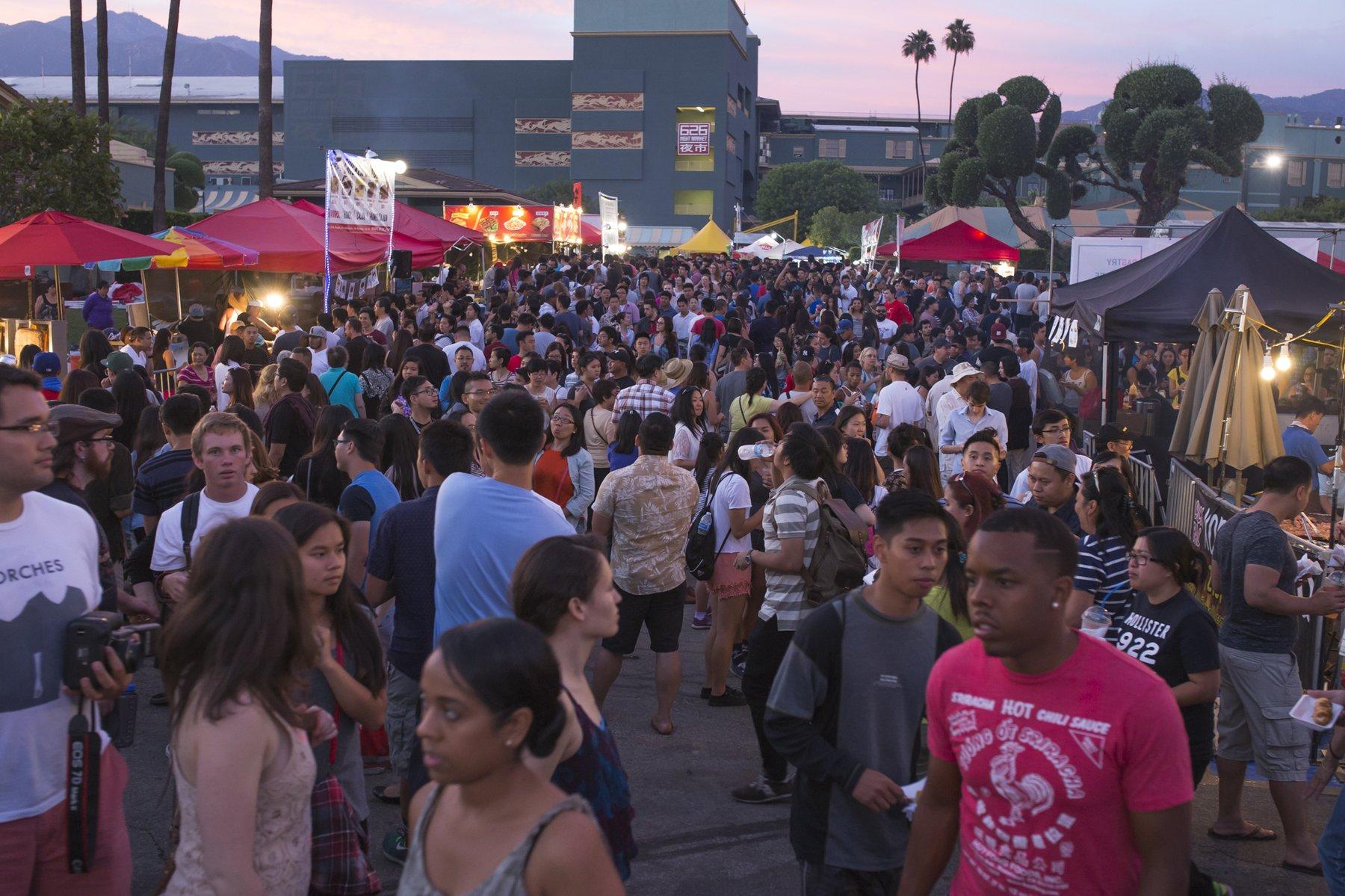
Photo by mrsamisnow. Licensed under CC BY 2.0. Resized for web
How an Area Code Became Southern California's Night Market
Jonny Hwang's 626 started as a homesick night market on a Pasadena block. It became the San Gabriel Valley's summer hangout.
November 10, 2026
In April 2012, one block of Old Town Pasadena tried to hold a Taiwanese night market. Tens of thousands of people showed up. Traffic stalled. Vendors ran out of food. A police helicopter hovered overhead. On Yelp, the one-star reviews arrived so fast that founder Jonny Hwang later joked about a world record. In an LA Weekly profile the next year, he said he hid in his room afterward.
Most first-time festivals would have stopped there. Hwang, his wife Janet Lan, and their friend Brian Gi kept going. They had named the event after the San Gabriel Valley's 626 area code, and the Valley already knew what that number meant. Within months the market moved to Santa Anita Park in Arcadia. It grew into the summer place where people from Alhambra, Arcadia, and Monterey Park run into each other under string lights, a California fairground hangout that never tried to pass for Taipei's Shilin Night Market on Huntington Drive.
Homesick for a ye shi
Hwang was born in Taiwan, spent a few childhood years in Kansas, then landed in Monterey Park and wondered, as he later told LA Weekly, whether the family had somehow driven back to the island. Chinese signage, dumpling houses, weekend dim sum: the San Gabriel Valley already felt dense with Asian life. For people who grew up with a ye shi, the missing piece was somewhere to wander at night.
In Taiwan, night markets are just how evenings work. Families graze. Teenagers linger. You buy three small things and keep walking. Hwang had spent years in Taipei running a lounge and reconnecting with Mandarin before returning to Los Angeles with Lan. In the suburbs, weekends felt quieter. Before the first 626, he told LA Weekly they wanted something to do besides clubbing and bar hopping, and a cheap stage for first-time vendors.
The name did half the work. By 2012, "the 626" was already youth slang and T-shirt copy, shorthand for Asian American kids raised on Mandarin school and boba runs. An LA Times Column One that summer described area-code pride showing up on shirts and in online handles. Putting those three digits on a night market told locals the night was theirs before the first skewer hit the grill.
From one jammed block to the racetrack
Pasadena was supposed to be a gateway. Organizers and the city both underestimated the pull. Press estimates for that first night ran from about fifteen thousand into the tens of thousands. A second Pasadena gathering near City Hall drew another enormous crowd. By September 2012, the Los Angeles Times was reporting the move to Santa Anita Park: more parking, more room, and a venue sitting squarely inside the 626.
Santa Anita became the flagship. On busy summer weekends, reporting put attendance near six figures across a three-day run, with hundreds of food, merch, and craft stalls. Marketplace walked the lot in 2017 and found nearly two hundred vendors selling stinky tofu beside ramen tacos and chicken-skin nachos. Nobody was there for the ponies.
People who grew up in Arcadia, Alhambra, San Gabriel, and Monterey Park talk about the market the way other cities talk about a boardwalk. In Frank Shyong's 2017 Los Angeles Times feature, a teenager from San Gabriel put it plainly: you always run into friends. That line explains more than any menu.
Asian memory, Asian American invention
Hwang has been clear that a U.S. night market cannot copy Taiwan street by street. Health-department rules, permits, and insurance push the format toward ticketed fairgrounds and fixed booths. On Marketplace he called the result an American-style evolution.
Early weekends leaned on Taiwanese and pan-Asian snacks people missed: stinky tofu, pig ears, takoyaki, shaved ice, bubble tea. Later seasons filled with lightbulb boba bottles, pho in taco shells, ramen folded into burgers and grilled cheese. Shyong's Times piece quoted Hwang saying the Asian American experience sits somewhere in the middle of "straight Asian" and "very Western," and that the stalls, left mostly to audience taste, keep rewriting what that middle looks like.
The market also became a cheap test kitchen. Vendors who found a line at Santa Anita have turned weekend pops into trucks and storefronts. Kenneth Nguyen of Rakken Tacos told the Times the feeling was weird and real: being part of your own community started to feel cool in public.
The area code goes on tour
Once the Arcadia weekends worked, the calendar stretched. In 2014 the team opened OC Night Market at the OC Fair & Event Center in Costa Mesa and tried a limited Downtown Los Angeles run. In 2018 a NorCal edition landed at the Alameda County Fairgrounds in Pleasanton after Bay Area fans kept driving south. Santa Monica followed in 2022. San Diego editions arrived later, first as a smaller downtown bazaar, then at larger venues including Mission Valley and Pechanga Arena. Around the pandemic years, the satellite brands mostly folded back under the 626 name.
Press and organizers have long billed the Arcadia weekend as the largest night market in the United States. That is the claim that stuck. What followed is easier to see on the calendar. Koreatown, Long Beach, and other SoCal nights sprang up in the same decade. Similar festivals appeared in cities that had never hosted anything like a ye shi. 626 gave Southern California a big, repeatable version of the format, with a name people already wore on their shirts.
In October 2025, Forbes reported that FoodieLand, a national food-festival producer, acquired 626 Night Market. CEO Julie Christine said the brand name and identity would stay put while the company pushed wider reach. Culture OC later framed the 2026 season as the first under that ownership. For regulars, the useful question is simpler: does the Arcadia lot still feel like the Valley's party? Ownership changed. The habit of showing up with friends is older.
Why people still go
Geographers call places like the San Gabriel Valley ethnoburbs: suburbs with their own banks, groceries, salons, and restaurants, built by and for ethnic communities. Wei Li popularized the term for this kind of middle-class Asian suburbia. For decades the Valley had the kitchens and the strip-mall density. What it still needed was a recurring outdoor room for the kids who grew up there, not only for their parents.
626 filled that gap almost by accident. Jennifer Medina's New York Times reporting on the Asian suburban shift quoted Hwang after the first jam: suddenly there was a community, and even outsiders wanted in. Marketplace later heard him estimate that nearly a third of attendees were non-Asian. Locals got a plaza. Visitors got an easy way into a food region that can feel coded from the freeway.
If you have walked Shilin or a Bangkok night bazaar, the American version will feel different. Tickets, wristbands, and fairground spacing change how freely you graze. 626 was always aiming for something closer to home: somewhere for the 626 to go on a Saturday night.
You still buy the skewer. You stay because someone you know is already in line.