
A Food Walk Through Manhattan Chinatown
Manhattan’s oldest Chinatown still cooks for people who live here. Roast-meat windows, dumpling shops, and the rooms that opened after.
Updated September 27, 2026
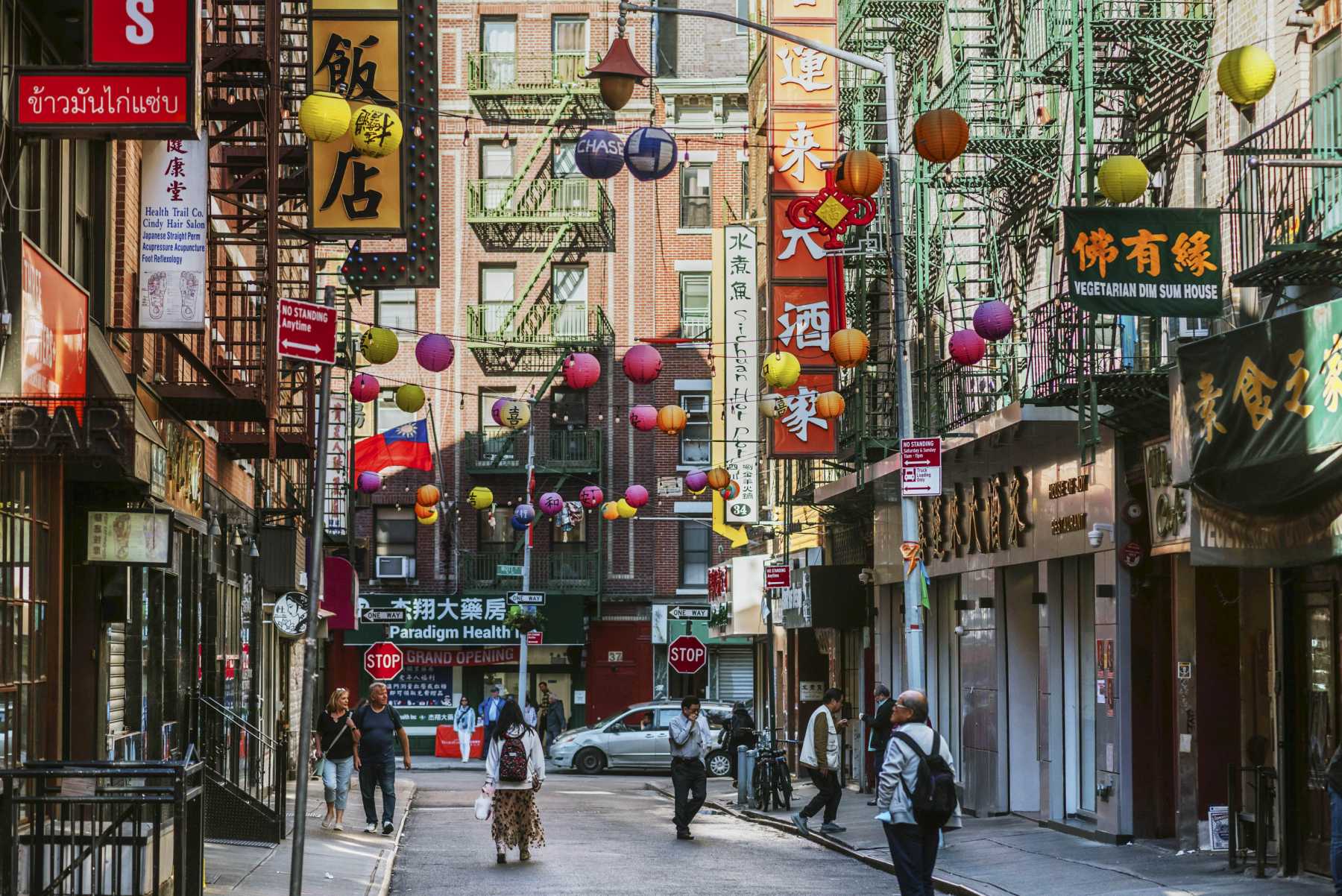
Photo by Lucía Vázquez. Licensed under NYC Tourism + Conventions. From the official Chinatown photo gallery; hosted locally
You turn from Mott onto Pell and the lanterns hang in a colored line over the asphalt. Signs for a dim sum house, a restaurant, a clinic, and a grocery share the same brick. People walk in the street as if it were a hallway.
This is the oldest Chinatown in New York, the Mott-Pell-Doyers core the New York Times called “China Town” in 1880. Flushing and Sunset Park grew larger. People still come downtown to eat.
Downtown Chinatowns in other American cities often emptied into gift-shop strips once families moved to the suburbs. Nick Tabor wrote in Curbed in 2015 that Manhattan’s still had residents and the shops that fed them. The rent is harder now, and Jing Fong, the banquet hall a lot of families used, closed in 2024. Roast ducks still hang in the glass. New dining rooms keep opening on the old streets.
How it got here
Chinese New Yorkers were already on Mott Street in the 1850s. Ah Ken, a Cantonese merchant, ran a boarding house there and later a cigar shop on Park Row. More men arrived from the West after the San Francisco riots of 1877. The Chinese Exclusion Act of 1882 then held the neighborhood small for decades, a few thousand people, almost all of them men.
The 1965 immigration law opened the door. Hong Kong and Guangdong families filled the west side of the Bowery through the 1970s and 1980s. Fuzhounese immigrants settled along East Broadway in the 1980s and 1990s, on a street that had been largely Jewish. That is why a single walk can still take you from a Cantonese roast-meat window to a Fuzhou peanut-noodle counter.
Jack Tchen, the historian who later helped start the Museum of Chinese in America, has said the restaurants defined Chinatown before tourists found it. Laundrymen and cooks came on Sundays for a meal that felt like home. You can still eat that way, a Sunday table and a plate of roast duck.
Start at Canal and Mott and walk south. The N, Q, R, J, and Z stop at Canal Street; the 6 is a short walk west. Cash still helps at the older counters, and the newer rooms take cards. Hours shift, so check before you plan around carts or a whole duck.
The rooms that have been here
Nom Wah Tea Parlor opened on Doyers Street in 1920, the oldest restaurant still running in the neighborhood. It began as a tea parlor and bakery. Wally Tang bought the place in the 1970s, and in 2010 his nephew Wilson dropped the carts so the kitchen could make plates to order from a photo menu. Sit for har gow and shumai if you want the oldest table on the bend. Doyers is a dogleg, and people stop for a picture. Farther down the street, Taiwan Pork Chop House does a thin glazed chop or a chicken leg over rice and pickled mustard greens.
Wo Hop opened downstairs at 17 Mott Street in 1938. The menu is Chinese American, the walls are covered in snapshots, and the James Beard Foundation named it an America’s Classic in 2022, their honor for a beloved regional restaurant. A street-level dining room opened in 2025. A few doors down, Hop Kee has been in the basement at 21 Mott since 1968, started by Peter Lee’s father after a stint cooking at Wo Hop. The crab in black bean sauce is the house dish. Those two basements are why late-night Chinatown used to mean this block. Hop Kee has been closing by 9.
Great N.Y. Noodletown has held the corner of Bowery and Bayard since 1981. Roast duck, char siu, and wonton soup, cash only, no reservations. A few steps down Bayard, Bo Ky has cooked Teochew food since 1990, the Chaozhou cooking of coastal Guangdong, with a country-style duck that is braised, a different bird from the roast ducks next door.
Joe’s Shanghai is how a lot of New Yorkers learned what a soup dumpling was. Chef Joe Si opened in Flushing in 1994, added Pell Street in 1995, and moved that branch to 46 Bowery at the end of 2019. Order the steamer when you sit. They make the dumplings to order.
Mei Lai Wah is the pork bun line, now at 41 Mott after a move. House of Joy, in the old Delight 28 banquet hall on Pell, still sends dim sum carts through a big room until mid-afternoon. Arrive before the lunch rush if you want the full parade.
East of the Bowery
Grand Street and East Broadway are where the Fuzhou counters thicken. Shu Jiao Fu Zhou, on Grand, is the peanut-noodle shop that keeps turning up in videos, and the pork-and-chive dumplings travel well with the noodles. Farther east, Wu’s Wonton King fills with birthday tables and a wonton soup that arrives in a bowl meant for sharing. It is BYOB. Bring a group. QQ Cafe, a small Fuzhou counter on East Broadway, is the same peanut-noodle idea in a tighter room.
The rooms that opened after
Uncle Lou sits on Mulberry Street because Louis Wong, who has done business in Chinatown for years, wanted a Cantonese dining room for the people who already ate here. Pete Wells, then the New York Times restaurant critic, wrote in 2022 that people were coming for Chinatown standards done with care. The menu is long on purpose. The lo wah kiu plates, the old-timers’ dishes, include steamed fish under ginger and scallion, and duck with dried tangerine peel.
On Chrystie Street, a group of friends who grew up in Chinatown opened Potluck Club in 2022, with Zhan Chen in the kitchen. The dining room looks like a small Hong Kong cinema. The salt-and-pepper fried chicken comes with scallion biscuits. In 2024 they opened Phoenix Palace on the Bowery, with a host stand built like a box office, on the block that once held Music Palace, Chinatown’s last movie theater.
On Doyers, Annie Shi opened Lei in 2025, twenty-eight seats above a mah-jongg club. Shi grew up in Queens, eating in Flushing, and already ran King and Jupiter, two downtown restaurants with long wine lists. The snacks are Chinese American: sesame shao bing, cumin lamb on cat’s-ear noodles, and wine that belongs with them.
Maxi’s Noodle, the Flushing wonton shop, now has a third counter at 68 Mott. It is a Flushing bowl on a Chinatown block. Go when you want soup and you are already on Mott.
If you have one night
Two rooms and a bun will do more for you than trying to finish the neighborhood. Come back for East Broadway, or for carts on a Sunday.
Flushing is a half-day from the 7 if you want a denser mainland map. This walk is the downtown one.
To start, we recommend Great N.Y. Noodletown or Nom Wah, then Uncle Lou or Potluck Club if you want a later table.