
Salt the Cabbage After the Nights Turn Cold
November 22 is Kimchi Day. In a 2025 survey, most people who make kimchi still put the work from mid-November into early December. A 10 kilogram box of brined cabbage is a real start, and it is smaller than the 18 heads a four-person family in that survey planned to buy.
Updated October 15, 2026
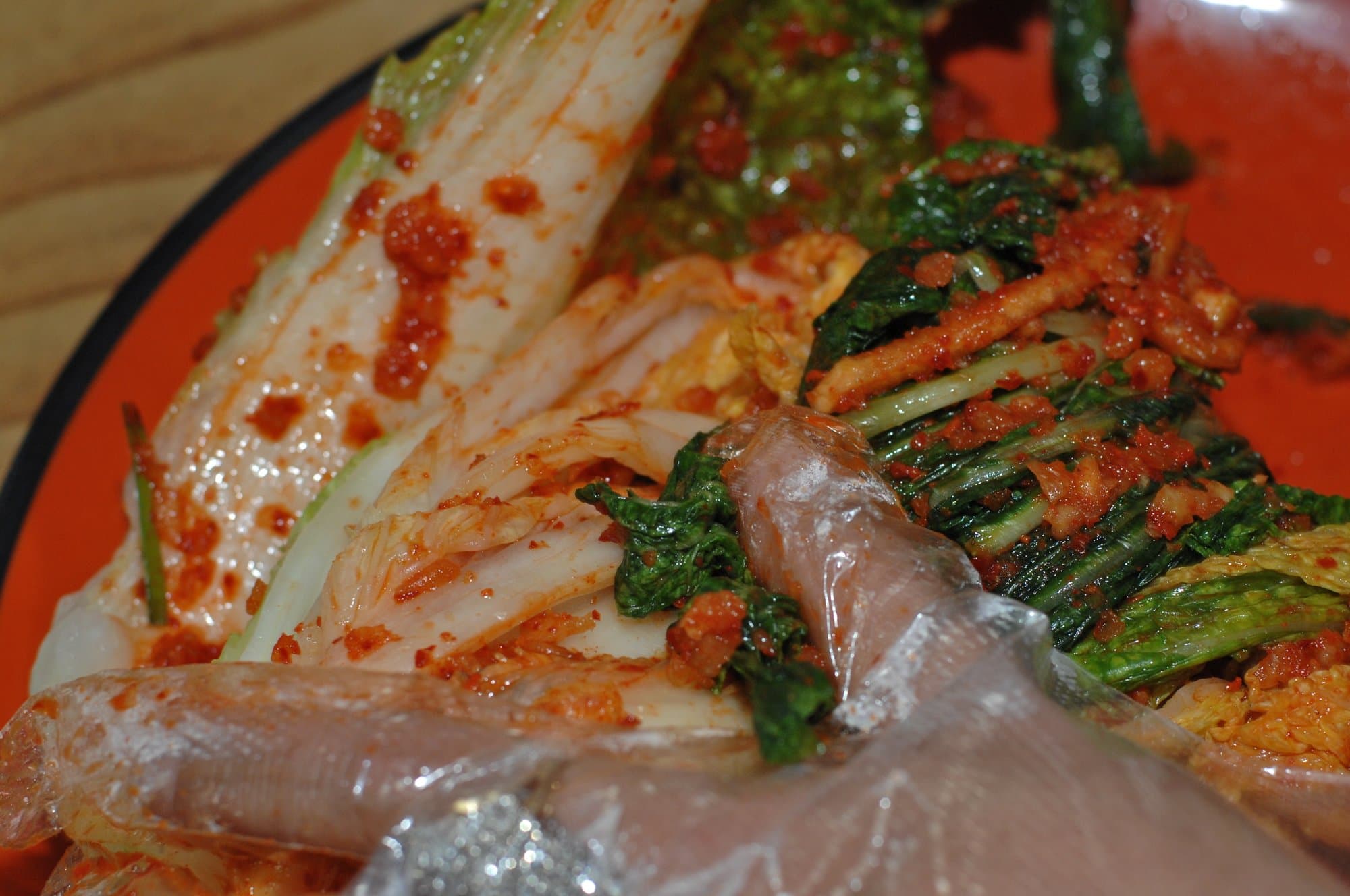
Photo by U.S. Army Garrison Humphreys. Licensed under CC BY 2.0. Kimchi making, October 15, 2011. Resized for web.
November 22 is Kimchi Day on the Korean calendar. The cabbage can wait for a colder morning.
The holiday is written into a statute. The salting follows the weather. In a national survey last year, most people who make kimchi put the work from mid-November into early December. Under the weather service’s old test, Seoul’s average date was November 29.
Three different names
Kimjang is the late-autumn making of kimchi in a quantity meant to last, and the habit of sending some of it to another house. In 2013 UNESCO inscribed that practice on the Representative List of the Intangible Cultural Heritage of Humanity, as Kimjang, making and sharing kimchi in the Republic of Korea. The note puts it in late autumn: a batch for the winter, and kimchi passed from house to house.
In 2017 the heritage office designated a wider practice. Kimchi making, regional styles included, became National Intangible Cultural Heritage No. 133 on November 15. No person or group was named as the holder. The office treated the work as a custom practiced across the country.
The legal holiday came later. A February 2020 amendment to the Kimchi Industry Promotion Act sets aside November 22. The government’s own briefing explains the numerals as eleven ingredients coming together and twenty-two benefits. That line is about the holiday. The salting still follows the cold.
Wait for the cold
The Korea Meteorological Administration used to publish a kimjang date. On February 11, 2016, it stopped producing that note, along with the blossom and foliage calendars, and passed them to private weather companies. Households can still use the test it published. Wait until the daily average stays at or below 4°C, about 39°F, and nights stay at freezing or below. Warmer than that, the jar ripens in a rush. If the cabbage freezes before it is seasoned, it is hard to get the flavor back.
Under that test, Seoul’s average date moved from November 25, in the record from 1920 to 1950, to November 29 in the record from 1980 to 2010. The weather service no longer publishes that date. Read the forecast for a few days in that cold range.
The Korea Rural Economic Institute asked 1,000 households that make or buy kimchi, from October 2 to October 13, 2025. Among those who named a time to make it, 73.1 percent chose mid-November through early December. Late November was the single busiest stretch. Around Seoul, and in Chungcheong, more people chose the middle and end of November. In Yeongnam, and in the southwest including Jeju, more people chose late November into early December. The institute expected most of the work to be finished by mid-December.
Eighteen heads, or one box
In the same survey, 62.3 percent of households still made their kimchi. Family taste was the reason they gave most often. Trust in the ingredients came next. Packaged kimchi was 32.5 percent, up from 29.5 percent the year before. People who bought the jar mostly wanted only as much as they would eat, or they wanted to skip the work.
A four-person family in the survey planned on 18.3 heads of cabbage. Their recent average was 21.2 heads. When households gathered to make the batch together, the average table was about two households and five people.
Brined cabbage is how many of those kitchens skip the longest chore. Among people making kimchi, 58.9 percent planned to buy the cabbage already salted, most often because the salting itself is a bother. Nonghyup, Korea’s agricultural cooperative, sells that cabbage in 10 kilogram boxes through its kimchi shop. One box will not stand in for 18 heads. It is enough to season in an afternoon, and enough to keep on one shelf.
The afternoon
Taste a leaf of the brined cabbage. If the salt bites, rinse and drain. The salt is already in the leaf. A second salting makes a harsh jar.
The Rural Development Administration publishes a proportion for cabbage kimchi. Scaled to 10 kilograms of brined cabbage, the paste is 450 grams of gochugaru, Korean chili powder on the coarse side, 200 grams of garlic, 100 grams of ginger, and 500 grams of jeotgal, salted seafood such as shrimp or anchovy. Cook a glutinous-rice porridge with one part rice and ten parts water, let it cool, and use about 850 grams. Matchstick about a kilogram of Korean radish, or a daikon if that is the radish in the store. Cut about 500 grams of scallion or another green. The formula also has a little sesame and a little sugar. Weigh what you can, then taste the paste. Some of the same shops sell a tub of seasoning next to the box. Taste that too. The shop blend and the institute’s weights are different recipes.
Work the paste between the leaves. Coat the outside and fold the head closed. Pack a container with the cut face up, so the seasoning stays in the leaves. Leave room under the lid, and cover the surface so air stays off the top. The institute’s window for flavor is two to three weeks at 3 to 5°C, just above freezing. A warm kitchen sours the batch faster. If the jar has to last for months, the institute says to leave the seafood and the leafy vegetables out. They sour the kimchi sooner. The weights above include both, which suits a batch you will eat in the first weeks.
Raw napa is the longer day. The same institute quarters the heads and soaks them about eight hours in a brine of about 15 percent salt, then rinses them two or three times in plenty of cold water and drains them. The brine is that salty, which is why the rinses matter. A bought box has already had the soak.
For 10 kilograms of brined cabbage
- 450 grams gochugaru
- 200 grams garlic and 100 grams ginger
- 500 grams jeotgal, salted shrimp or anchovy
- About 850 grams cooled glutinous-rice porridge, cooked with one part rice and ten parts water
- About 1 kilogram Korean radish, cut in matchsticks, and 500 grams scallion or another green
- 50 grams sesame and 50 grams sugar
The first bowl
Give the jar those cold weeks before you decide how it turned out. Then eat it with hot rice. You are looking for a leaf that is still a little crisp, and a sourness that has started. If the jar is already sharp after a few warm days, the next batch can wait for a colder night.