
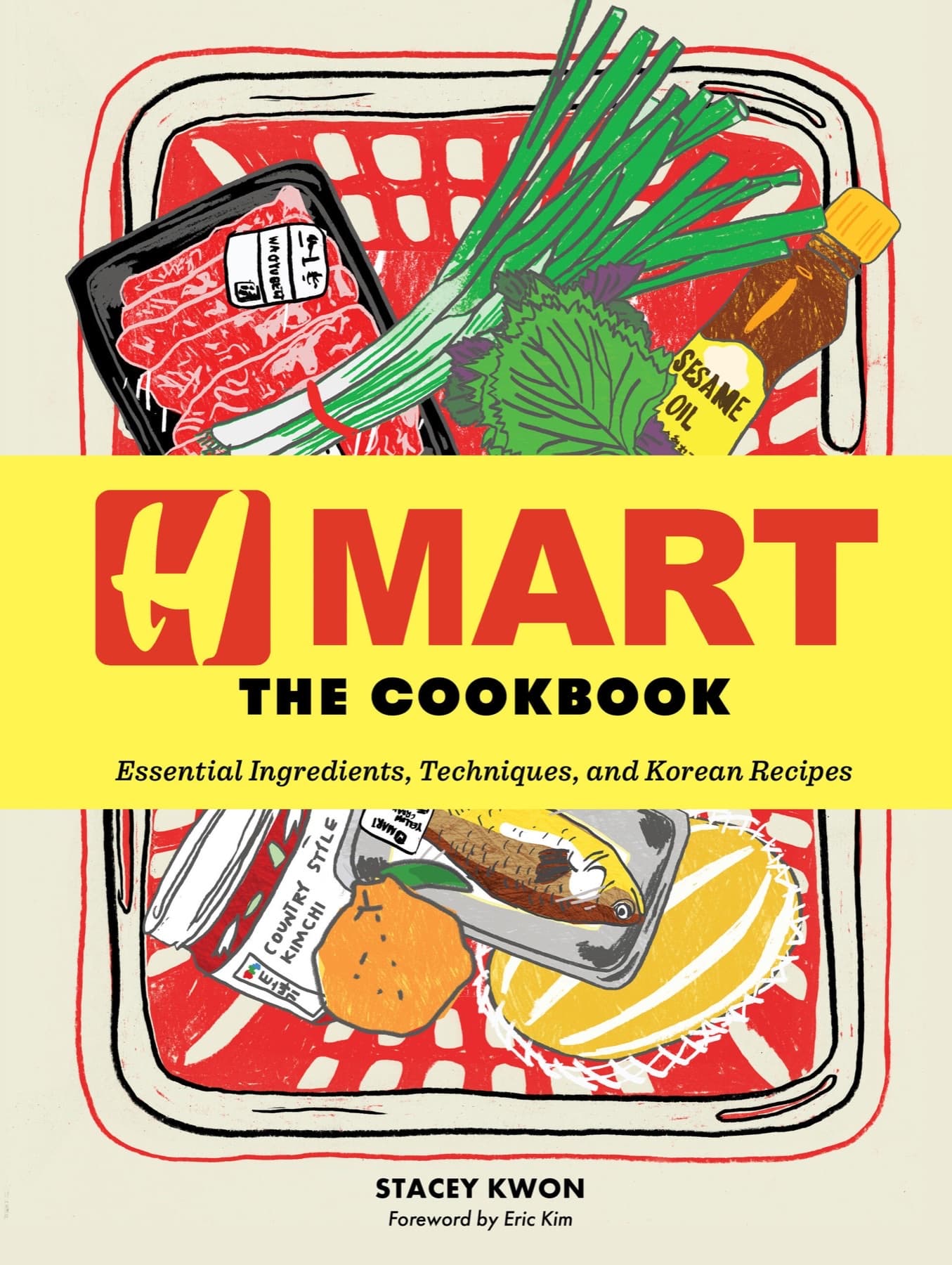
Photo by Artisan Books / Hachette Book Group / H Mart. Licensed under Press. Official publisher cover art; resized for web.
Stacey Kwon Put H Mart’s Shopping Basket Into a Cookbook.
H Mart’s first cookbook is out today. President Stacey Kwon wrote 75 Korean recipes and a guide to the aisles her father opened in Queens. Eric Kim wrote the foreword.
October 6, 2026
The cover looks like you just left the checkout. A red H Mart basket holds scallions, perilla leaves, sesame oil, country-style kimchi, a striped yellow melon, and a tray of thinly sliced beef. A yellow band across the middle names the book: H Mart: The Cookbook.
It went on sale today from Artisan Books, the first cookbook from the supermarket chain that taught a lot of American kitchens how to stock Korean flavor. Stacey Kwon wrote it. She is H Mart’s president, and the daughter of Il Yeon Kwon, who opened the first shop in Woodside, Queens, in 1982. The hardcover is 336 pages and costs $50. Eric Kim, the New York Times cooking writer, wrote the foreword.
The early store was called Han Ah Reum, Korean for an armful of groceries. Kwon grew up inside it. Inc, writing on publication day, describes her sliding down conveyor belts into the storage room as a kid, and playing hide-and-seek with her brother among the refrigerated cases. When the sneaker shop next door closed, her father took that space too. The family market started to stretch.
Publisher materials now count about 135 H Mart locations and rising. Walk into one and the feeling is still specific. You can find the gochujang your mother named by brand, the short rib cut for a Tuesday grill, and a tub of banchan without making a second stop. Shoppers who never grew up with doenjang on the counter end up there too, standing in front of the same walls, trying to decide which bottle comes home first.
The cookbook tries to settle that decision before you get to the parking lot. Food & Wine says Kwon spent four years on it, gathering about 75 recipes she grew up cooking and eating. There is oi muchim, the cool spicy cucumber salad that disappears at the start of a meal. Galbi jjim, short ribs braised until the meat gives. Japchae, glass noodles slick with sesame. Then the kitchen gets playful: fish-shaped bunggeoppang waffles stuffed like pizza instead of red bean, and a cheese buldak kimchi fried rice that puts hot sauce, kimchi, and mozzarella in the same pan.
Publishers Weekly noticed that the chapters follow a supermarket walk, through produce, seafood, pantry staples, and prepared foods, with sidebars on what those ingredients are and how to use them. That matters as much as the dinner photos. A lot of people already love what comes out of an H Mart cart. Fewer people feel steady when they stop at the dried-anchovy wall and wonder which bag belongs in a weeknight soup.
H Mart has always been a store and a teacher. It keeps exact brands on the shelf for families who already know them, and it quietly shows everyone else how those brands fit an ordinary dinner. Kwon’s book puts that teaching on paper you can leave next to the rice cooker.
Longtime shoppers will recognize the flavors and finally have a reason to cook what keeps ending up in the cart. Newer ones can treat the cover as a gentler first visit. The scallions and sesame oil are already labeled. Dinner can start from there.