
Photo by East Table. Licensed under Editorial. AI-generated editorial illustration; no people.
Why Every American Town Has a Chinese Takeout Joint
Chinese kitchens reach every state and 70 percent of counties. Exclusion-era law left restaurants as one of the few jobs Chinese immigrants could keep.
September 27, 2026
Drive through a town with one supermarket and a high school football field and the Chinese takeout is usually there, a lit window on a strip that otherwise goes dark at 8. Pew Research Center counted American restaurants in March 2023 and found Chinese kitchens in every state and in 70 percent of counties. About 73 percent of counties have any Asian restaurant at all. Chinese kitchens account for almost all of that reach.
Jennifer 8. Lee, in her 2008 book The Fortune Cookie Chronicles, put the national count near 40,000, more than McDonald’s, Burger King, and KFC combined. Later tallies bounce. Pew’s county map is the part that has not moved.
The first documented rooms opened in Gold Rush San Francisco in 1849. The record usually names Canton Restaurant, or Norman Asing’s Macao and Woosung on Kearny Street, where Asing, an English-speaking merchant, fed politicians as well as Chinese miners. Most of the cooks came from Taishan, a county in Guangdong that sent a huge share of the early Chinese migration.
The Chinese Exclusion Act of 1882 barred laborers and locked Chinese immigrants out of most wage work and out of naturalization. A person could still open a laundry or a restaurant. In 1915 a federal appeals court treated restaurant owners as merchants, which meant an owner could travel home and sponsor relatives. Legal historian Heather Lee, who traced that visa through immigration files, found Chinese restaurants in New York nearly quadrupled between 1910 and 1920, then more than doubled again. Nationwide, economist Susan Carter found the count doubled in each of those decades. Partners pooled money for high-grade chop suey palaces so one investor could sit as the merchant for a year and keep the papers clean.
The dish that paid the rent was chop suey. Andrew Coe, in Chop Suey, his history of Chinese food in America, describes a Taishan mix-fry that New York’s Chinatown cooks adapted for American plates in the 1880s. Bohemians on Mott Street wanted filling food that was cheap. After Li Hongzhang, a Qing diplomat, visited New York in 1896, newspapers tied him to the stew. Restaurant men used the publicity. Li had brought his own cooks.
Yong Chen, a historian at UC Irvine, calls Chinese food the first mass-consumed ethnic cuisine in the country, cheap and fast enough that he has compared chop suey to a Big Mac before McDonald’s. Unions spent about thirty years trying to legislate the shops away. Gabriel Chin, writing in the Duke Law Journal, documented boycotts and bills meant to keep white women out of the rooms. People kept ordering. The rooms also stayed open on Sundays and on Christmas, which is how they became a habit in Jewish neighborhoods on the Lower East Side.
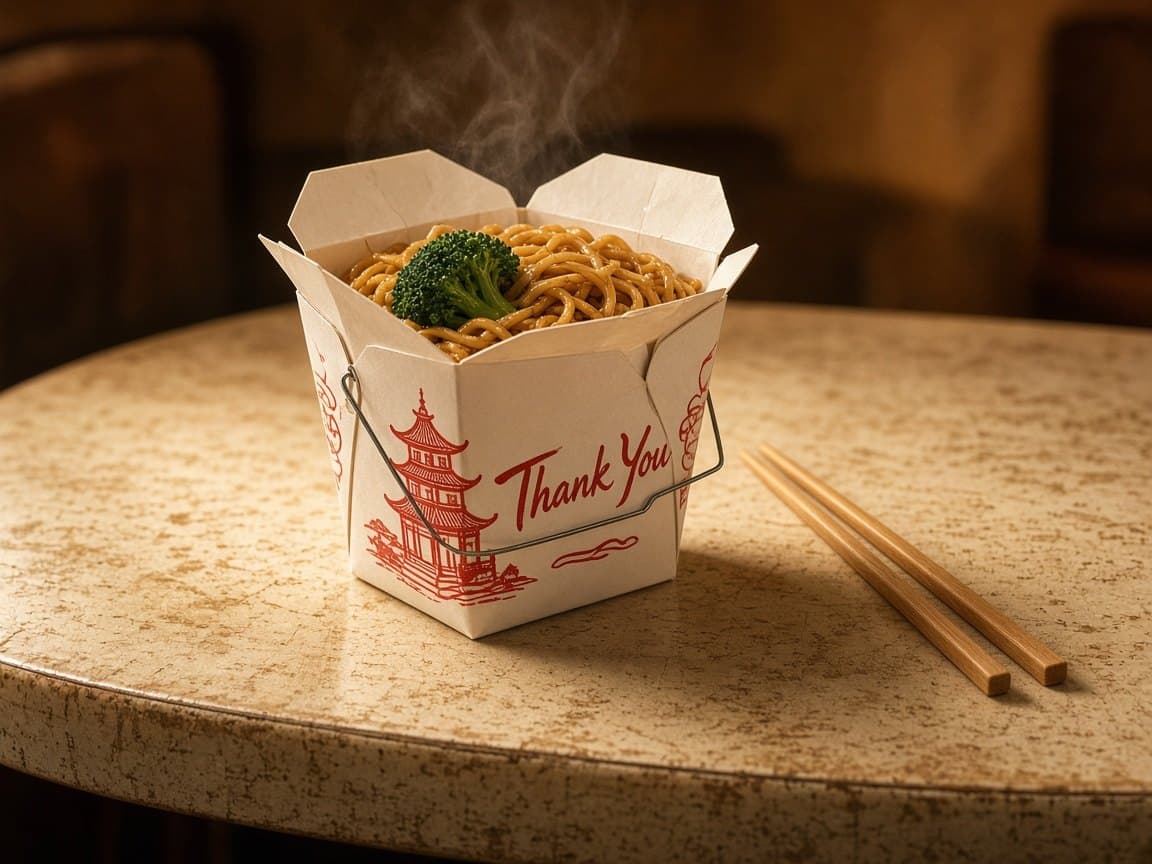
The carton is American. Frederick Weeks Wilcox of Chicago patented a folded paper pail on November 13, 1894, a leak-resistant box with a wire handle, first meant for shucked oysters. Chinese kitchens picked it up after World War II, when suburban families started taking dinner home. In the 1970s a designer at Fold-Pak, the big carton maker, added the red pagoda. The box is rare in China.
Congress reopened immigration in 1965 with the Hart-Celler Act, which ended the old national-origin quotas. Cooks arrived from Taiwan and Hong Kong, then from the mainland, and menus started saying Hunan and Sichuan. Nixon’s 1972 banquet in Beijing, shown with Peking duck, sent diners looking for heat. Peng Chang-kuei, a Hunan chef who had cooked for the Nationalist government in Taipei, made General Tso’s chicken in the 1950s for an American admiral. New York kitchens sweetened and crisped it in the 1970s. Buffet lines run by immigrants from Fujian carried that plate across the eastern United States in the 1990s.
Sociologist Zai Liang followed those workers out of Manhattan’s East Broadway, where employment agencies post jobs by area code and buses run to Ohio, Kentucky, and Tennessee. Chinatown stays the hiring hall. The restaurant opens in a town that has no Chinatown.
Some of those windows are closing. The New York Times found in 2019 that the share of Chinese restaurants had fallen in metro areas, and that many owners were glad. Their children had college jobs. Jennifer 8. Lee called the closings a success. People came to cook so their children would not have to.
New regional rooms keep opening in the cities. Pew’s map still has a Chinese kitchen in most counties. Tonight the light is on, and the carton is the same folded pail: the cheapest hot dinner on a street that does not have much else open.