
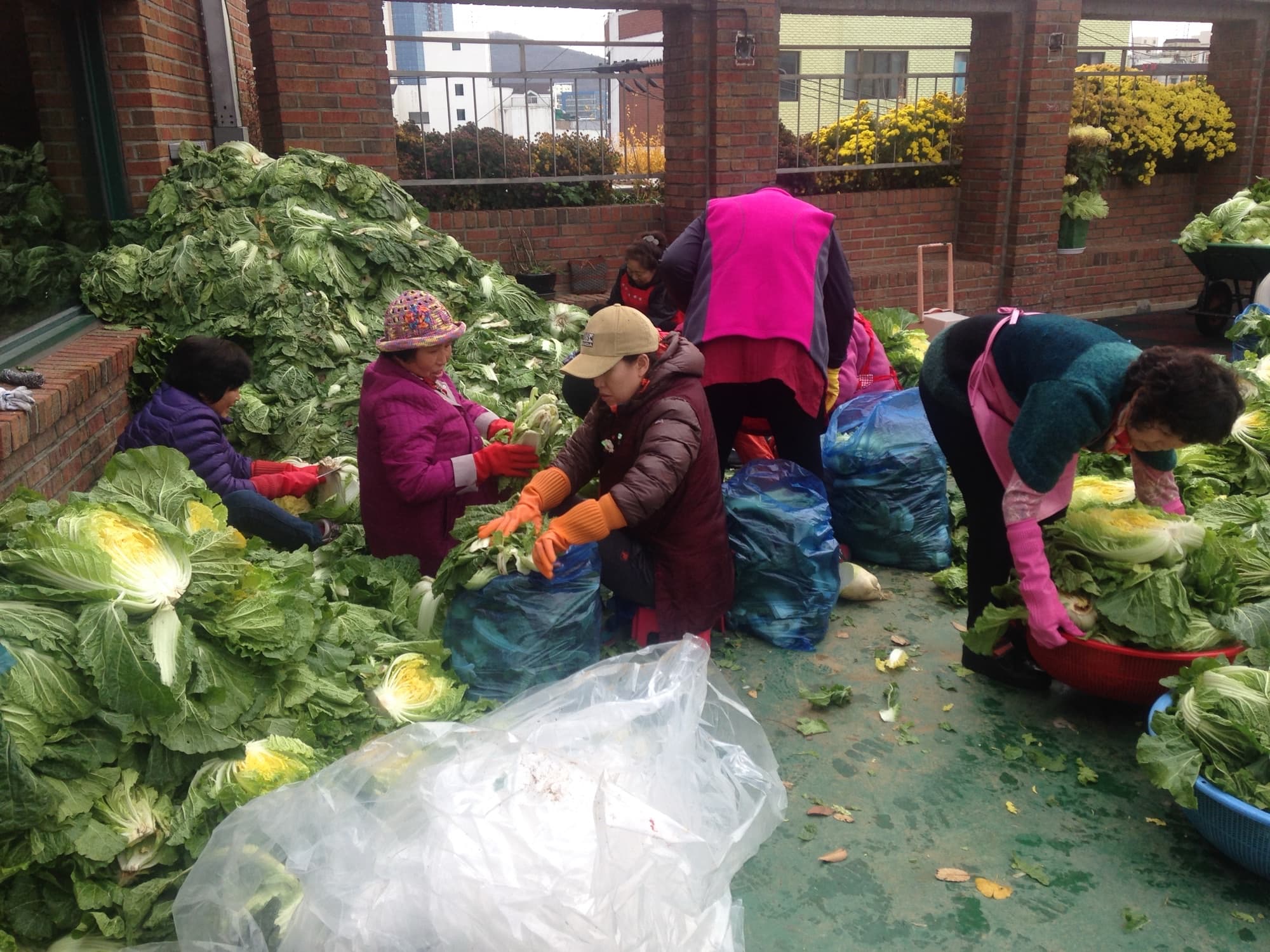
Photo by Manju Shakya. Licensed under CC BY-SA 4.0. Kimjang in Korea, November 22, 2016. Resized and cropped for web.
Fewer Homes Are Making Kimjang. Korea Is Paying to Keep the Habit.
A November 3 package puts a record 64 billion won into winter ingredient discounts. KREI says only 58.6 percent of households plan to make kimchi themselves this year.
November 3, 2026
On November 3, South Korea’s agriculture and oceans ministries announced a winter package built around cabbage, radish, salt, and salted shrimp. Their “2026 Kimjang Ingredient Supply and Demand Stabilization Measures” put a record 64 billion won into farm and seafood discounts, up from 50 billion last year. The measures run from November 9 through December 6. The Asia Business Daily and SBS English both cast the spend as help for shoppers and for farmers facing a bumper crop. According to the Korea Rural Economic Institute, only 58.6 percent of households plan to make kimchi at home this year, down 5.6 percentage points from 64.2 percent a year earlier.
Kimjang is the late-autumn making and sharing of kimchi. UNESCO inscribed that practice in 2013: a batch large enough for winter, and some of it sent to another house. Fewer kitchens are signing up for the full day. The ones that still do are not shrinking their piles by much. KREI’s four-person household plan sits at 23.4 heads of napa cabbage, almost unchanged from 23.5. Because fewer households are making any batch at all, the agriculture ministry estimates kimjang cabbage demand at 583,000 tonnes, down 9.1 percent from last year.
Production is up. A ministry official told Asiae that favorable weather should lift autumn napa cabbage about 18.5 percent and autumn radish about 11.1 percent. SBS, citing KREI prices as of October 30, put a head of cabbage at 3,969 won, down 23.5 percent from a year earlier, with radish, onion, and green onion also cheaper. Salted fermented shrimp, saeujeot, was the outlier, up 25.8 percent to 19,025 won per kilogram. Seo Joon-han, food-policy director at the Ministry of Agriculture, Food and Rural Affairs, told SBS that cabbage and radish should stay soft on price, and that even with thinner garlic and saeujeot production, kimjang-season supply looks sufficient.
The discounts are meant to move that cabbage into kitchens. Of the 64 billion won, 44 billion goes to agricultural products and 20 billion to seafood. Shoppers can see up to 40 percent off kimjang ingredients and pork for boiled suyuk at large and mid-size markets, plus agricultural vouchers sold at a 20 percent pre-discount. Seafood discounts reach up to 50 percent on sun-dried salt, salted shrimp, anchovy sauce, and oysters. The government has also pre-secured 46,500 tonnes of cabbage and 9,000 tonnes of radish for emergencies, and plans to send stockpiled chili, garlic, and onion to processors and distributors. In a Korea.net briefing, officials said E-Mart’s 20-kilogram pre-salted cabbage box was already listing around 29,800 won after a 40 percent card discount.
The afternoon had already gotten shorter before this year’s coupons. In KREI’s 2025 consumer survey, 62.3 percent of households still made kimchi and 32.5 percent bought commercial kimchi, up from 29.5 percent the year before and from 25.7 percent in 2022. People who bought the jar most often wanted only as much as they would eat, or they wanted to skip the work. Among households that still made a batch, 58.9 percent planned to buy cabbage already salted. Salting itself was the chore they named most often.
Retail numbers this fall keep pushing the same way. Seoul Economic Daily reported in October that packaged kimchi sales at Lotte Mart rose about 5 percent in the first nine months of 2026, while E-Mart’s packs of one kilogram or less climbed 6.6 percent. At Kurly, packaged kimchi transactions jumped 35 percent from July through September, with the smallest packs, 100 grams to one kilogram, rising fastest. E-Mart raised its pre-salted cabbage reservation pool to about 75,000 boxes and added kimjang kits that pair brined cabbage with seasoning. For many kitchens, the remaining work is opening a box and deciding how much paste to buy.
Agriculture Minister Song Mi-ryung told Asiae that kimjang is a UNESCO-listed culture, and asked people to join a “make and share one more head” campaign for farmers and neighbors. Oceans Minister Hwang Jong-woo promised to ease the shopping-cart burden with those seafood discounts. Local governments and Nonghyup are lined up for making events, sharing drives, rural experience villages, and bulk buys for company employees to give away.
Cheaper cabbage helps the basket. The long afternoon of three generations rinsing cabbage together still depends on who shows up. More of the season now runs through pre-salted leaves, kits, small refrigerated packs, and gift orders from a company cafeteria. Kimchi still reaches the table. The discounts settle what a head costs. Who still gathers for the batch is a separate question.