
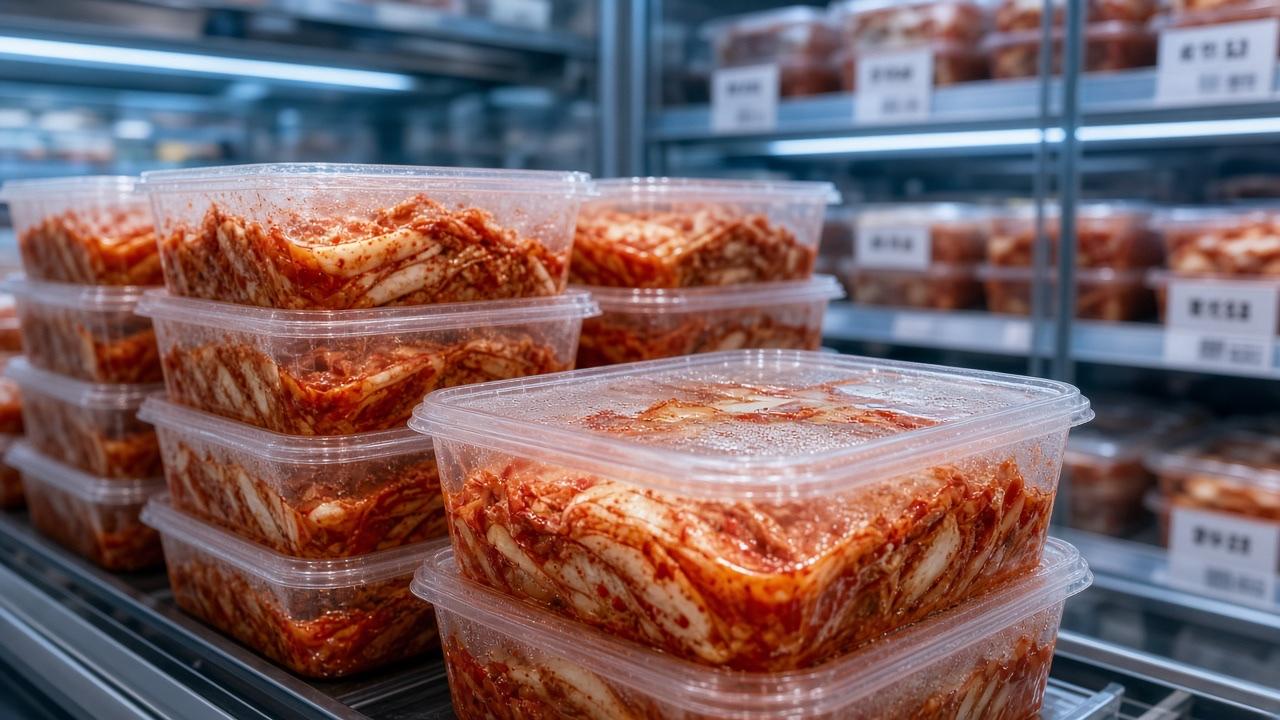
Photo by East Table. Licensed under Editorial. AI-generated editorial illustration of packaged kimchi in a refrigerated case; no people or brand logos.
More Koreans Are Buying Their Kimchi Even as Making It Gets Cheaper
In KREI’s October survey of 1,000 households, 41.4 percent planned to buy packaged kimchi. Buyers mostly wanted smaller portions and less work, even as kimjang ingredients got cheaper.
November 18, 2026
Kimjang is the late-autumn job of packing enough kimchi for winter. This year the cabbage got cheaper, and more Korean households still said they would buy the jar instead of making the batch. The Korea Rural Economic Institute asked 1,000 households online between October 2 and 12 for its “2026 Consumer Kimjang Intentions and Major Vegetable Supply Outlook.” Respondents were 20 and older and lived across 17 provinces and cities. In that group, 41.4 percent planned to buy commercial or packaged kimchi, up from 35.9 percent a year earlier. The share that planned to make kimchi themselves or get it from family and acquaintances fell to 58.6 percent from 64.1 percent.
Making it at home still looks cheaper on paper. The Korea Agro-Fisheries and Food Trade Corporation priced a twenty-head kimjang basket at 199,456 won as of November 9, about 9 percent below early November 2025. KREI put a four-person household’s late-October kimjang cost about 4 percent lower than last year. Today the Korea Price Association went further. For a family of four making whole-cabbage kimchi, kkakdugi, and chonggak kimchi with traditional-market ingredients, it counted 339,670 won. Buying those same volumes ready-made averaged 772,620 won, roughly 2.3 times the homemade total. Buyers in the KREI survey rarely named that gap. They talked about how much they would eat, where they would keep it, and how much work they wanted to do.
Portion
Of the people planning to buy packaged kimchi, 43.9 percent said they wanted only as much as they needed. Households cutting back a homemade batch said the same thing in different words. Among them, 42.9 percent pointed to lower kimchi consumption at home, and 16.3 percent said they still had kimchi left over. More than half of the households that still make kimjang, 53.5 percent, now expect the batch to last ten months or longer, up 5.8 percentage points from last year.
Stores are selling smaller packs into that gap. Seoul Economic Daily and Herald Business both reported that E-Mart’s packaged kimchi in packs of one kilogram or less rose 6.6 percent in the first nine months of 2026. Lotte Mart’s packaged kimchi sales were up about 5 percent over the same stretch. At Kurly, packaged-kimchi transaction volume jumped 35 percent from July through September, and packs from 100 grams to one kilogram rose fastest. The kitchens that still make a pile are not shrinking it much. Asia Business Daily, citing KREI, put expected napa use among makers at 28.9 heads this year, almost unchanged from 29.0. More people are skipping the pile and opening a tub.
Storage
A winter batch needs cold space that stays steady. Gallup Korea’s 2025 appliance survey found a kimchi refrigerator in 85 percent of households, down from 90 percent in 2021. Among people living alone, the machine is common later in life and scarce earlier: 79 percent of singles 60 and older said they had one, against 27 percent of singles 50 and younger. Herald Business quoted a Seoul resident in their 40s who ordered packaged kimchi partly because they had no kimchi refrigerator and did not want a large container cycling through a regular fridge.
In an ordinary refrigerator, a homemade tub competes with milk and takeout, and every door opening warms the cabbage. A small refrigerated pack fits the shelf you already have. Sixty percent of the KREI respondents who buy commercial kimchi said they order it online or through TV home shopping, so most of the cold storage happens before the bag reaches the door.
Labor
The next reason to buy, at 34.4 percent, was that making kimchi is a hassle. Only 9.0 percent said the store product was cheaper than making it, and 8.1 percent said they did not know how. UNESCO describes kimjang as neighbors and families making and sharing large quantities so every house has enough for winter. The day still means salting, rinsing, mixing paste, and packing. Even among households that still make a batch, 46.6 percent said they would start with salted cabbage rather than fresh heads, ahead of the 42.8 percent who planned to salt their own. People in their 50s leaned hardest on the pre-salted leaves.
Direct making still rises with age in the KREI numbers. Under 30, only 17.9 percent planned to make kimchi themselves. Among respondents 60 and older, the share climbed to 37.1 percent. Packaged buying crossed 40 percent in every broad age band and peaked at 45.4 percent among people in their 50s. When buyers weighed what to put in the cart, taste and quality led at 57.7 percent. Price came in at 9.7 percent.
Kimchi is still on Korean tables. Cheaper cabbage helps anyone who wants to pack a winter batch. The survey says a growing share would rather buy a portion that fits the fridge and skip the long afternoon at the sink.